Sterile packaging is more than a sealed pouch or rigid tray. It is a controlled barrier that protects medical products from microorganisms, moisture, particles, and handling damage. Understanding how sterile packaging ensures product safety requires attention to materials, sealing, sterilization compatibility, transport, and opening technique.
The World Health Organization’s Global Patient Safety Action Plan identifies healthcare-associated infections as a continuing worldwide risk. In parallel, FDA guidance and ISO 11607 emphasize validated packaging systems for terminally sterilized medical devices. Smithers’ industry analysis, The Future of Sterile Medical Packaging to 2028, also highlights growing demand for reliable barrier performance, sustainability, and supply-chain resilience. These reports point to one practical truth: sterility must survive until the moment of use.
Packaging engineer Walter Soroka wrote, “Packaging is the science, art, and technology of enclosing and protecting products.” His observation applies strongly to sterile healthcare products. A package may look flawless, yet a microscopic seal channel, puncture, or weak corner can compromise safety. That is why manufacturers use seal-strength testing, dye penetration tests, microbial barrier studies, and simulated shipping trials.
The process is not perfect. Human handling still matters. A nurse can tear a pouch incorrectly, or a tray can suffer damage during transport. Effective sterile packaging therefore combines validated design, documented controls, trained users, and continuous monitoring. Its safety depends on the entire system, not appearance alone.
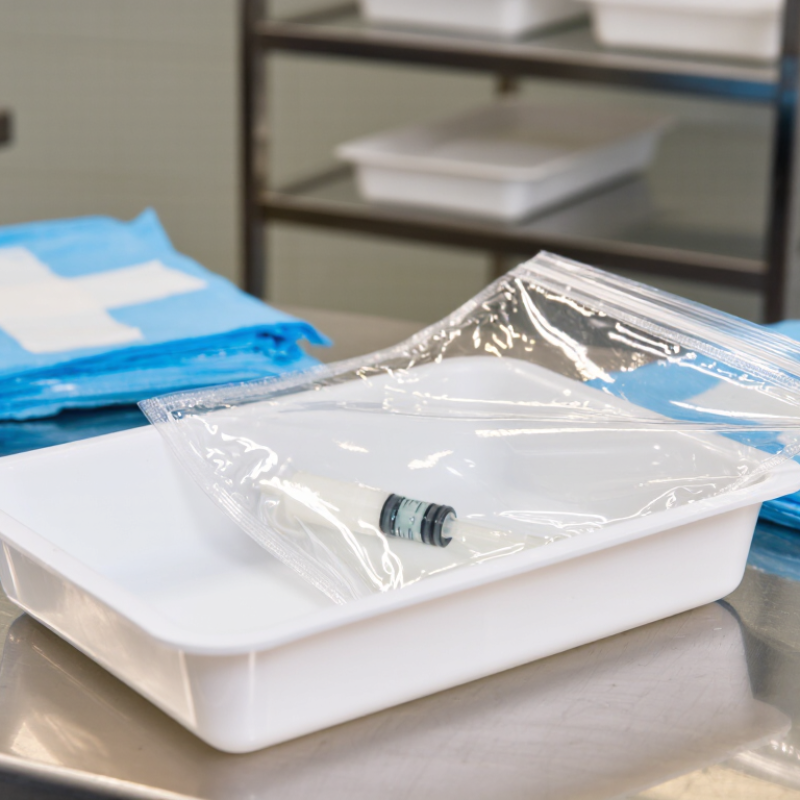
Definition and Purpose of Sterile Packaging
Sterile packaging is a controlled barrier system designed to keep a sterilized product safe until use. Its purpose is not merely to wrap an instrument. It must block microorganisms, dust, moisture, and physical damage during storage and transport. Common formats include sealed pouches, rigid trays, and protective wraps. The correct design depends on the device, sterilization method, shelf life, and handling conditions. In a clinic, a nurse should be able to open it without touching the sterile contents. That practical moment matters.
Safety begins with material selection and validated sealing. Testing checks seal strength, package integrity, microbial barrier performance, and resistance to shipping stress. A seal that looks smooth may still contain a weak channel. A tiny puncture can allow contamination. Sterilization indicators provide useful process information, but they do not prove complete sterility by themselves. Reliable packaging programs combine testing, documented procedures, trained operators, and controlled storage. Clear labels also help staff identify damage, expiration information, and opening instructions.
There is an important limitation. No package remains safe if it is crushed, wet, opened, or stored beyond its validated conditions. Even careful systems can fail when real handling differs from laboratory testing. For that reason, manufacturers and healthcare teams should review complaints, transport damage, and inspection records. A package may look acceptable, yet its history can reveal a problem. That is where careful judgment remains essential.
What Is Sterile Packaging and How Does It Ensure Safety? - Definition and Purpose of Sterile Packaging
| Sterilization Method |
Typical Process Conditions |
Compatible Packaging Materials |
Main Safety Benefit |
Important Limitations |
| Moist Heat / Steam |
Saturated steam under pressure; commonly 121–134 °C, with cycle time determined by the load and equipment. |
Heat-resistant metal, glass, and selected autoclavable polymers and medical-grade wraps. |
Rapid and reliable destruction of microorganisms, including many bacterial spores, when the cycle is properly validated. |
Not suitable for moisture-sensitive materials, many electronics, oils, or some heat-sensitive plastics. |
| Dry Heat |
Hot air at higher temperatures than steam, often around 160–180 °C for validated exposure periods. |
Glass, metal, powders, and selected materials that tolerate prolonged high temperatures. |
Provides sterilization without moisture and is useful for materials that may be affected by steam. |
Longer cycles and higher temperatures can damage polymers, seals, adhesives, and other heat-sensitive components. |
| Ethylene Oxide (EO) Gas |
Low-temperature gas process; cycle parameters vary with humidity, temperature, gas concentration, load, and aeration requirements. |
Many heat- and moisture-sensitive polymers, assembled devices, and porous medical packaging systems. |
Can penetrate complex shapes, narrow spaces, and porous loads that are difficult to sterilize by heat. |
Requires controlled aeration because residual EO must be reduced to acceptable limits; the process also requires strict safety controls. |
| Gamma or Electron-Beam Radiation |
Ionizing radiation delivered at a validated absorbed dose; the exact dose depends on the product and bioburden. |
Sealed, radiation-compatible polymers, films, trays, and certain disposable medical products. |
Sterilizes packaged products after sealing, reducing the risk of post-process contamination. |
Radiation may cause discoloration, embrittlement, oxidation, or changes in material performance over time. |
| Vaporized Hydrogen Peroxide |
Low-temperature vapor or plasma-assisted cycles, commonly below approximately 60 °C, depending on the system. |
Selected heat-sensitive metals, plastics, and instruments compatible with the validated process. |
Leaves minimal residues because hydrogen peroxide breaks down primarily into water and oxygen under appropriate conditions. |
Limited penetration through long narrow lumens, dense loads, cellulose-based materials, and some packaging configurations. |
How sterile packaging ensures safety:
Sterile packaging provides a validated microbial barrier, protects the product from moisture, particles, handling, and physical damage, and maintains sterility until the package is opened or its integrity is compromised. Effective systems typically combine suitable packaging materials, validated sealing, sterilization compatibility, package-integrity testing, and controlled storage and transport.
Note: Process conditions and material compatibility are general industry ranges. Final sterilization cycles and packaging designs must be validated for the specific product, load, equipment, and applicable regulatory requirements.
Key Materials and Structural Components
What Is Sterile Packaging and How Does It Ensure Safety?
Key Materials and Structural Components
Sterile packaging is a controlled barrier system, not simply a clean wrapper. Its materials must protect medical devices from microbes, moisture, dust, and handling damage. ISO 11607-1 requires packaging materials to maintain sterility until the point of use. That sounds straightforward. It is not.
Common materials include medical-grade paper, spunbonded polyolefin, polyethylene, polypropylene, and multilayer films. Paper supports controlled microbial barrier performance while allowing sterilization gases to pass through. Film provides visibility and moisture resistance. Tyvek-like nonwoven structures are often selected for strength and low particle release, but every material has limitations. A strong film can still fail at a weak seal.
The structure usually includes a sterile barrier, a protective outer layer, seals, and opening features. Seal width, peel strength, and seal integrity require documented testing under ISO 11607-2. ASTM F88 evaluates seal strength, while ASTM F1929 can detect channel leaks in porous packages. These details matter because a tiny channel may look harmless but compromise the barrier.
The World Health Organization’s 2022 infection prevention report estimates healthcare-associated infections affect about 7% of patients in high-income countries and 15% in low- and middle-income countries. Packaging cannot solve every infection risk. It can, however, reduce preventable exposure when materials, seals, labeling, and transport controls work together. Real-world handling remains the weak point. A perfect design may still fail after compression, vibration, or careless opening.
How Sterile Packaging Maintains Product Safety
Sterile packaging maintains product safety by creating a controlled microbial barrier from final sterilization through use. Its pouch, tray, lid, and seal must work as one sterile barrier system. The FDA’s aseptic-processing guidance emphasizes package integrity, validated sealing, and protection during storage and transport. A clean-looking pouch can still fail. Tiny channels, weak seals, or rough handling may allow contamination without visible damage.
The WHO Global Patient Safety Report 2024 estimates that one in ten patients experiences harm in healthcare, with more than half considered preventable. Packaging cannot solve every safety problem, but it can reduce one important risk: exposure before use. Manufacturers therefore test seal strength, microbial barrier performance, aging, vibration, compression, and temperature changes. ISO 11607 also requires documented validation for packaging systems used with terminally sterilized medical devices. In practice, operators inspect seal width and wrinkles, while laboratories use methods such as bubble emission or dye penetration testing. These checks are valuable, though no test detects every real-world failure.
Tips: Match the packaging material to the sterilization method. Record lot numbers and inspection results. Do not trust appearance alone. During transport, review punctures, crushed corners, moisture, and separated seals. A practical weakness remains: rushed visual inspections can miss small damage, so periodic destructive testing and staff retraining deserve attention.
Sterilization Methods and Packaging Validation
What Is Sterile Packaging and How Does It Ensure Safety?
Sterile packaging protects a medical device after sterilization and during transport. Its barrier must resist microbes, moisture, punctures, and repeated handling. ISO 11607-1 requires packaging systems to maintain sterility until the point of use. That sounds simple. It is not.
Sterilization depends on the device and materials. Steam uses moist heat and is widely considered the most reliable method for heat-resistant products. Ethylene oxide reaches complex shapes but requires controlled aeration. Radiation can treat sealed packages, although polymers may change with dose. ISO 11135, ISO 17665, and ISO 11137 define process expectations for these methods. A 2022 World Health Organization report estimated that 7 in 100 acute-care patients in high-income countries acquire at least one healthcare-associated infection. Packaging failures are not the only cause, but they can add avoidable risk.
Validation links laboratory evidence with real handling conditions. Teams test seal strength, dye penetration, burst resistance, aging, vibration, and distribution simulation. ISO 11607-2 also expects documented forming, sealing, and assembly processes. Accelerated aging can predict shelf life, yet it cannot perfectly reproduce years in a warehouse. That limitation deserves attention. A 2023 industry survey from the Healthcare Compliance Packaging Council reported that seal integrity and material compatibility remain frequent quality concerns. Reliable validation therefore includes routine monitoring, trained operators, and investigation of damaged samples, not just a successful initial test.
Storage, Inspection, and Safe Handling Requirements
Sterile packaging protects medical products from microorganisms, moisture, particles, and physical damage. Its safety depends on more than the package design. Storage, inspection, and handling must remain controlled until the item is used. In clinical and manufacturing settings, trained staff should follow approved procedures and record relevant conditions. Temperature, humidity, light, and cleanliness can affect package performance, especially during long storage periods.
Tips: Store packages in a clean, dry area away from sharp edges. Keep them off the floor. Use older stock first, when appropriate. Check the seal, label, expiration date, and barrier surface before use. Do not use a package with tears, punctures, open seals, stains, or unusual moisture. Small damage is still damage.
Inspection should happen before moving the package and again before opening it. Handle sterile barriers gently, using clean hands and suitable protective equipment. Avoid dragging, crushing, folding, or placing heavy items on top. If a package falls, inspect every surface carefully. If its condition is uncertain, quarantine it and request a qualified review. Expiration dates matter, but they are not the only concern. Packaging may fail after poor transport, repeated handling, or exposure to unsuitable conditions. A practical inspection record should identify the item, date, observed issue, and action taken. No system is perfect; rushed checks and unclear storage records remain common weaknesses. Examine the process, not only the package.
Sterile Packaging: Storage, Inspection, and Safe Handling
Cleanroom classification helps control airborne contamination during sterile packaging operations. The chart shows the ISO 14644-1 maximum concentration of particles ≥0.5 µm per cubic metre for selected cleanroom classes.
Key requirements: Store sterile barrier systems in a clean, dry, temperature-controlled area; inspect seals, labels, and package integrity before use; and handle packages with clean hands or gloves while avoiding crushing, puncturing, moisture, and unnecessary contact.
Particle limits are based on ISO 14644-1 cleanroom classification values at ≥0.5 µm.
Conclusion
Sterile packaging is a controlled barrier system designed to keep medical, pharmaceutical, laboratory, and other sensitive products free from harmful microorganisms until the package is opened. Its purpose is to protect product quality, preserve sterility, and support safe use throughout transportation and storage. Common materials include medical-grade paper, specialized films, rigid trays, lids, seals, and protective layers. Together, these components create a durable structure that resists punctures, moisture, dust, and contamination while still allowing authorized sterilization processes to work effectively.
Understanding how sterile packaging ensures product safety involves more than selecting suitable materials. Packaging must be compatible with methods such as steam, radiation, or gas sterilization and must undergo validation to confirm seal strength, integrity, and performance over time. During storage, packages should remain in clean, dry, controlled conditions and be inspected for tears, broken seals, discoloration, or other damage. Proper handling also requires minimizing unnecessary contact, following established procedures, and removing any package that appears compromised before use.

 SwellMed Medical